
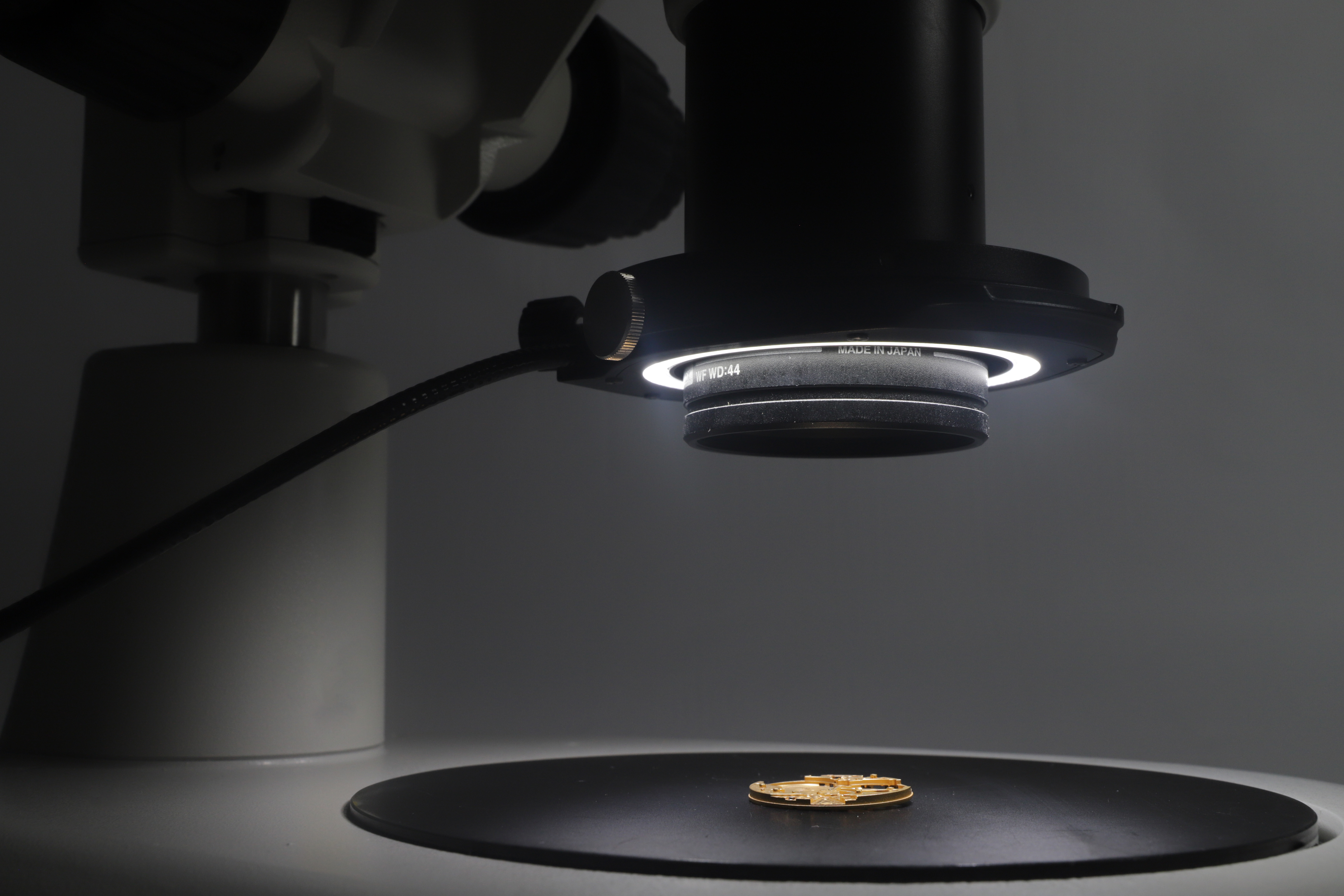
Under a stereo microscope, the sample is rarely the problem
What is brightfield illumination?
In brightfield, light falls on the sample from above, at a steep angle close to the opticalaxis. Most of the light is reflected back into the objective, so the field of view is bright andthe sample appears with its real colours.
Brightfield is the right choice for general observation: checking colours, readingengravings, inspecting assemblies, measuring features or verifying finishing quality. Itsweakness is subtle relief. On a polished or flat surface, a fine scratch reflects almost thesame amount of light as the area around it, so it barely stands out.
What is darkfield illumination?
In darkfield, light reaches the sample at a low, grazing angle. On a perfectly flat surface,the light is reflected away from the objective and the background stays dark. As soon asthere is a scratch, an edge, a particle or a deposit, light is scattered upwards into theobjective, and the defect lights up against a dark background. For a detailed opticalexplanation, see the Evident darkfield illumination guide.
This is why darkfield is so effective for micro-scratches, burrs, edge defects, dust, contamination and fine texture. It reveals the topography of the surface rather than its colour.
Brightfield vs Darkfield at a Glance
LIGHT ANGLE
Brightfield: Steep, close to the optical axis.
Darkfield: Low, grazing illumination.
BACKGROUND
Brightfield: Bright background.
Darkfield: Dark background.
BEST FOR
Brightfield: Colour inspection, general structure, assembly verification, and measurement.
Darkfield: Detecting scratches, edges, particles, deposits, and surface relief.
LIMITATIONS
Brightfield: Fine surface details can disappear on flat or polished parts.
Darkfield: Colours and flat surface features are less clearly rendered.
Typical applications
- Watchmaking and precision mechanics. Check finishing, engravings and assembly inbrightfield, then look for micro-scratches and burrs in darkfield.
- Electronics and microtechnology. Verify component placement and solder joints inbrightfield, then detect contamination or coating defects in darkfield.
- Medical devices and laboratories. Observe surface finishes in brightfield, then revealtexture and fine discontinuities in darkfield.
Why combining both gives the best results
Most real inspections need both views. Switching between them on the same microscope,without moving the part, saves time and removes doubt: if a mark only appears indarkfield, it is relief or contamination, not a colour difference.
What makes good microscope lighting
Whatever the angle, three properties decide how much you see:
1. Uniformity. Uneven light creates bright spots and dark zones that hide defects orcreate false ones.
2. Directionality. Light that goes exactly where it should gives more contrast and fewerparasitic reflections.
3. Colour quality. A daylight colour temperature and a high colour rendering index (CRI)keep colours faithful and reduce operator fatigue.
The same principles apply in automated inspection, as explained in our article How to optimize image quality through lighting.
VisiBright and VisiDark: brightfield and darkfield with LuxiBright®
L.E.S.S. designed two ring lights that mount directly around the objective of stereomicroscopes, with compatibility tables and adapters for Zeiss, Nikon, Olympus and Leica.
- VisiBright for brightfield: ultra-uniform, directional light, 50–150 mm working distance,5400 K or 6500 K, CRI > 90, dimmable from 0 to 100%.
- VisiDark for darkfield and grazing light: adjustable 0–15 mm working distance, 5400 K,CRI > 90, no heat at the sample.
Both are based on LuxiBright® nano-active fiber technology, which delivers uniform lightwithout the hotspots of LED ring lights. Used together, they give a complete view of thesample.
Frequently asked questions
Can I use darkfield on any stereo microscope? Yes, with a darkfield ring light mountedaround the objective, such as VisiDark, which offers adapters for the main microscopebrands.
Is darkfield better than brightfield? Neither is better: they reveal different things.Brightfield shows colour and structure, darkfield shows relief and contamination.
Why does a scratch disappear under my ring light? On a flat or polished surface, ascratch reflects almost as much light as its surroundings under steep lighting. Grazinglight makes it scatter light and stand out.
What colour temperature should I use? A daylight temperature around 5400 K with a CRIabove 90 gives faithful colours and comfortable observation.
See the difference on your own parts
Request a quote or read our application notes.