
Great image quality starts with the right light
In machine vision, choosing a high-performance camera is only part of the equation.
Even the best imaging system can struggle when lighting conditions are not properly controlled. Low intensity, glare, poor contrast or uneven illumination can hide edges, distort shapes and make critical features difficult — or even impossible — to inspect.
The right lighting geometry and technology can make all the difference.
Here are four key elements to consider when designing lighting for a machine vision application.
1. Control the lighting angle
The angle at which light reaches an object directly influences what the camera can see.
Depending on the surface, geometry and features being inspected, changing the lighting angle can reveal edges, textures and defects that would otherwise remain hidden.
For reflective or complex surfaces, controlling the angle is particularly important to minimize unwanted reflections and glare while highlighting the features that matter most.
The objective is not simply to illuminate the object, but to direct the light exactly where it provides the most useful information to the camera.
2. Choose the right lighting type
Different inspection tasks require different lighting geometries.
Ring lights, bar lights and other illumination configurations interact differently with the inspected object. Selecting the appropriate lighting type depends on several factors, including the shape, material, surface characteristics, working distance and features to be detected.
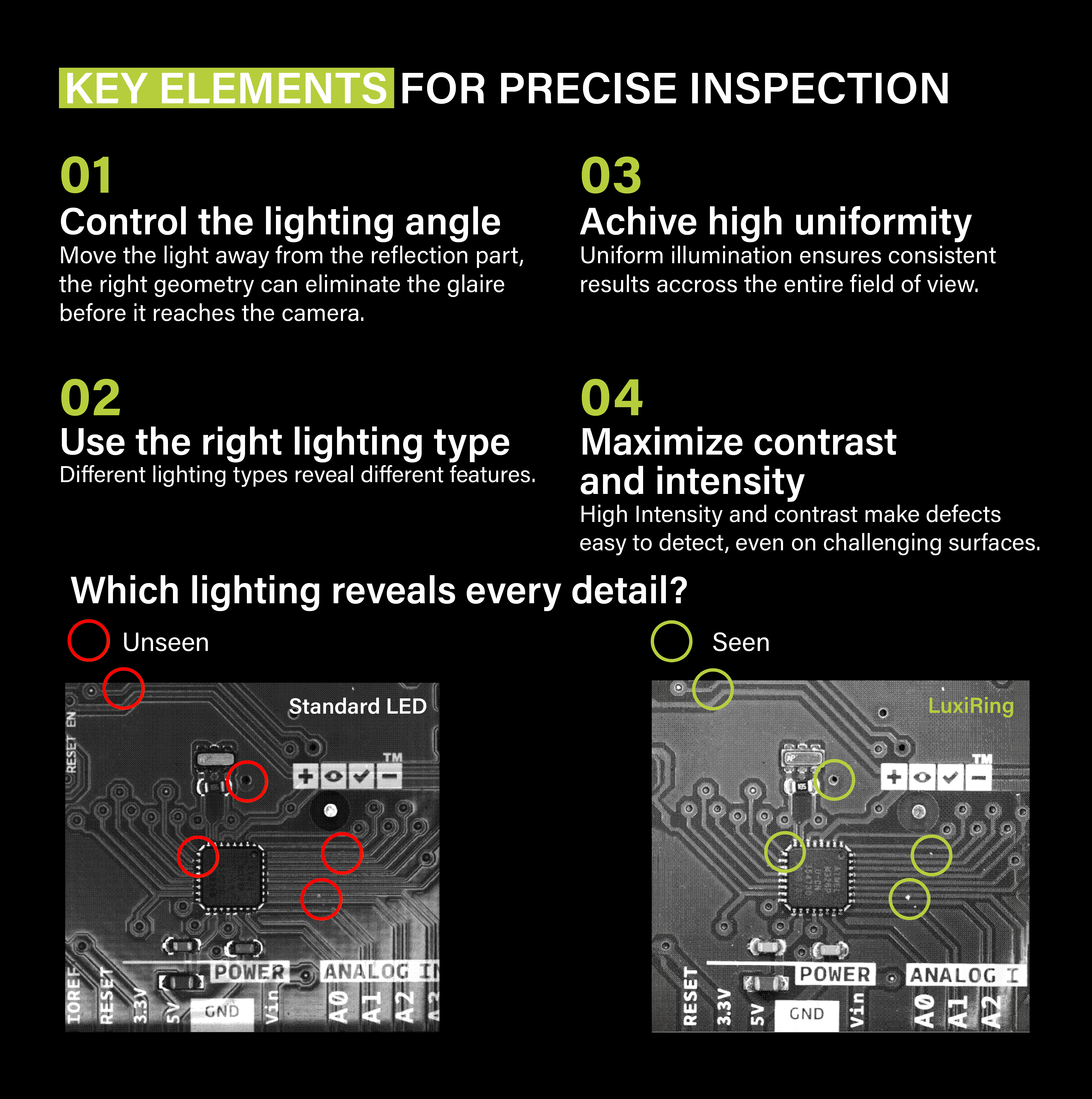
For applications requiring compact and highly uniform illumination around the optical axis, for example, a ring light such as LuxiRing can provide an effective solution.
Choosing the right lighting architecture from the beginning can significantly improve image quality and simplify the overall vision system.
3. Achieve high uniformity
Uniform illumination is essential for reliable image processing.
Variations in brightness across the field of view can create artificial gradients, shadows or hotspots. These variations can make image analysis more complex and reduce the reliability of automated inspection.
A highly uniform light source helps ensure that the same feature appears consistently across the entire inspected area.
This is particularly important for applications requiring repeatable measurements, defect detection or high-precision quality control.
With its ultra-thin light guide and precise light distribution, LuxiBright® technology is designed to provide highly uniform illumination for demanding machine vision applications.
4. Maximize contrast and intensity
A machine vision system needs more than a bright image. It needs an image where the relevant information is clearly distinguishable.
The right combination of contrast and light intensity helps separate the features of interest from their surroundings, making edges, defects, markings or surface variations easier for the camera and image-processing system to detect.
Higher usable contrast can also reduce ambiguity in image processing and contribute to more robust inspection results.
The goal is therefore not simply to maximize brightness, but to deliver the right amount of light with the right distribution and geometry.
Better light. Better images. More reliable inspections.
Lighting should never be treated as an afterthought in machine vision.
By carefully controlling the lighting angle, lighting type, uniformity, contrast and intensity, it is possible to significantly improve the quality of the image before any image-processing algorithm is applied.
The comparison between standard LED lighting and our LuxiRing solution demonstrates how the right illumination technology can reveal details more clearly and provide a more consistent image for inspection.
Because when it comes to machine vision:
Better light means better images — and better images mean more reliable results.