
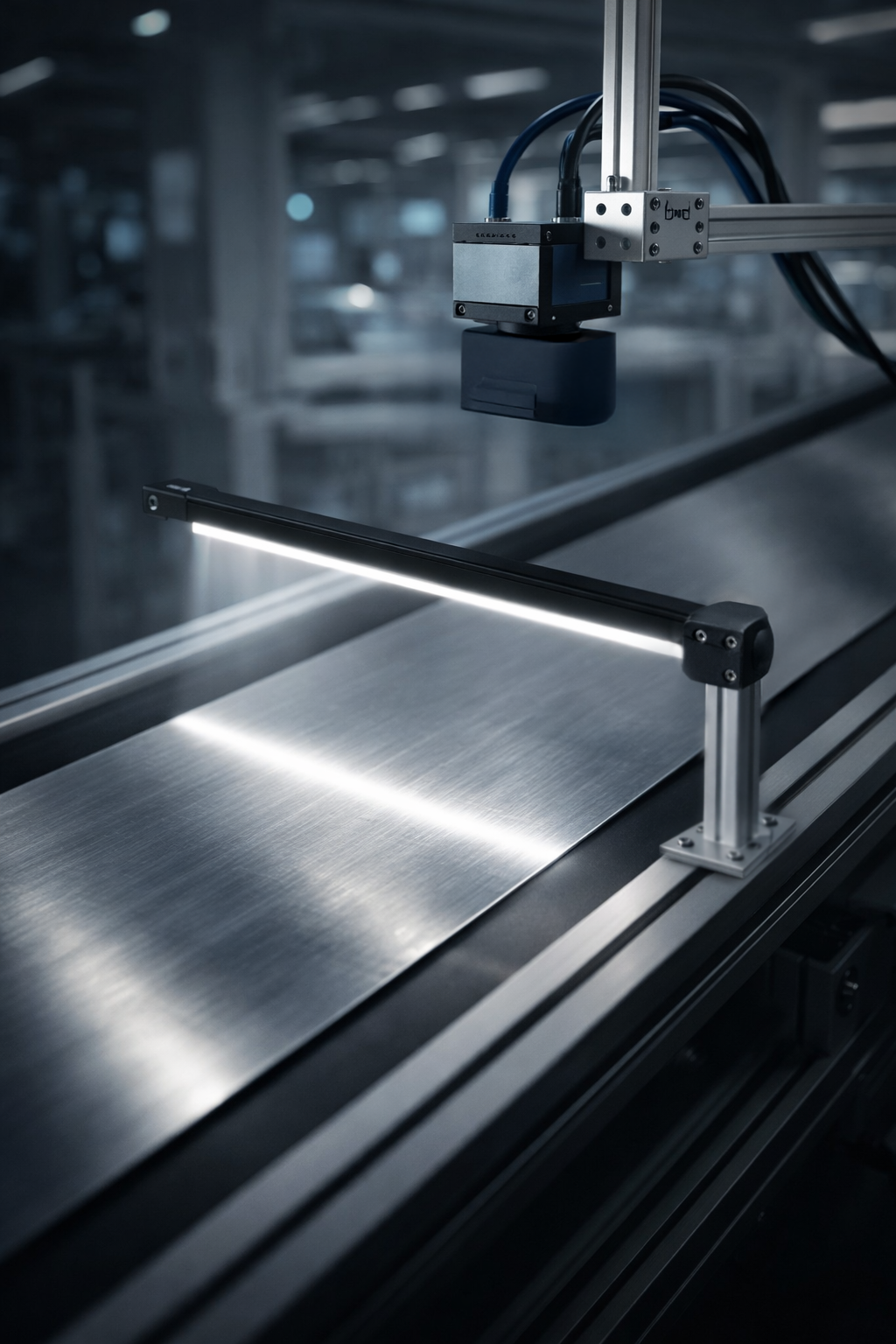
Line scan cameras build an image one line at a time, as the product moves past the sensor.They are the reference for long or continuous products: webs, glass, film, printedsurfaces, cables, batteries and parts on conveyors. But they are very sensitive to onething: the uniformity of the light along the scan line.
Why line scan imaging needs uniform light
A line scan camera sees a thin strip of the product. Each pixel of that strip is lit by adifferent part of the bar light. If the light is brighter in the middle than at the ends, thesame pattern appears on every line of the image: a bright band in the centre and darker edges.
The consequences are concrete:
- False defects at the edges, where the image is darker.
- Missed defects in the centre, where higher brightness can saturate the sensor.
- Heavy flat-field correction in software, which amplifies noise in the dark zones.
- Unstable results when the light ages unevenly.
Line scan systems also need more light than area cameras, because concentrating lightinto a very thin line is optically inefficient, as explained in this Vision Systems Design article on lighting for line scan imaging.
The hidden cost of LED bar lights: the drop at both ends
Most bar lights are built from a row of LEDs behind a diffuser. Near each end, there arefewer neighbouring LEDs to overlap with, so intensity falls off. To get a usable uniformzone, integrators often oversize the light: a 500 mm bar to light 300 mm properly.
Oversizing has a price. The light is longer, heavier and harder to fit in the machine, and itoften has to sit further from the product, which reduces intensity on the scan line. Addingmore LEDs is not always the answer either, as we explained in Do more LEDs mean betterimage quality?
5 criteria to choose a line scan light
1. Uniform length, not total length. Ask for the uniformity profile along the bar, not onlyits dimensions.
2. Beam angle. A narrow beam concentrates light on the scan line and limits stray lightand reflections. A wider beam is more tolerant to position changes.
3. Intensity at working distance. Line scan cameras often run at short exposure times,so the light must be bright on the line, not only at the source.
4. Size and weight. A compact light can be placed closer to the product and integratedmore easily.
5. Stability over time. Uniformity that drifts means recalibrating the system.
LuxiLine: 100% of its length is usable
LuxiLine is a machine vision bar light based on LuxiBright® nano-active fiber technology. Instead of a row of LEDs, light is emitted along an engineered optical fiber, so brightnessstays uniform from one end to the other. A 300 mm LuxiLine gives 300 mm of uniform light.
- Standard lengths of 300, 600 and 900 mm, and any custom length on request.
- An ultra-directional 15° beam angle that concentrates light on the inspection line.
- A slim, lightweight design that can be placed close to the sample, along conveyors orinside vision enclosures.
You can configure your LuxiLine online with LuxiConfig Machine Vision, or discover all our machine vision lighting solutions.
Frequently asked questions
Why are my line scan images darker at the edges? Most often because the bar light losesintensity at its ends or is too short for the field of view. Flat-field correction cancompensate, but a light that is uniform over the full width is more robust.
How long should my bar light be? With a conventional LED bar, usually longer than thefield of view. With a light that is uniform end to end, such as LuxiLine, its length can matchthe field of view.
Which beam angle should I choose? A narrow angle like 15° maximises intensity on theline and reduces stray light. Choose a wider angle if the product height varies.
Can LuxiLine be made to a custom length? Yes. Beyond the 300, 600 and 900 mmstandards, every LuxiLine can be built to your exact length.
Struggling with uneven line scan images?
Send us a sample image and our team will tell you whether lighting is the cause. Request a quote or configure your LuxiLine.