
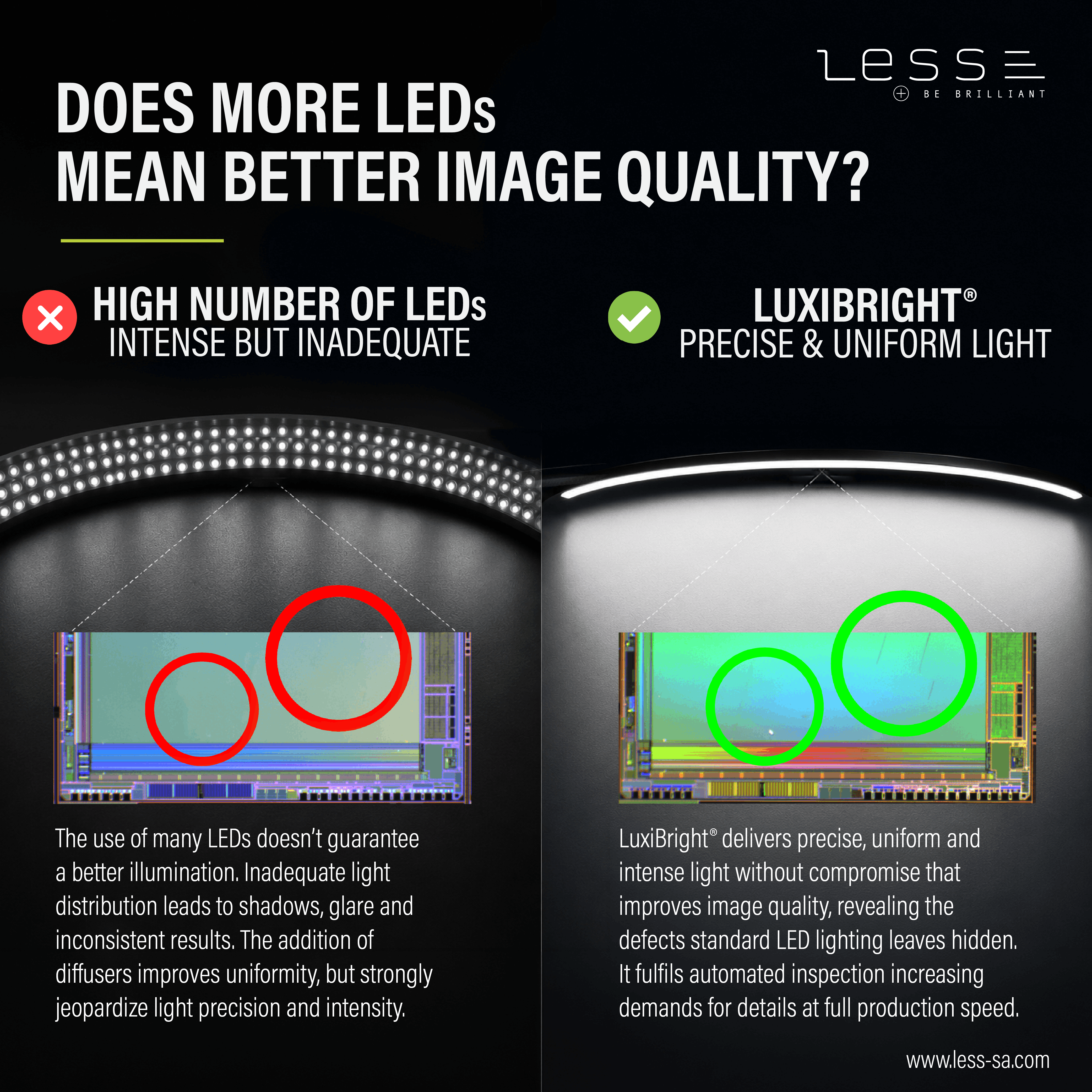
More LEDs. More light. Better images?
It might seem logical: the more LEDs you use, the better the illumination — and therefore the better the image quality.
But in machine vision, it is not that simple.
Image quality depends on much more than the amount of light reaching the object. Uniformity, directionality, intensity and precision all play a critical role in revealing the details that matter to an inspection system.
More light does not automatically mean better information for the camera.
The limitations of conventional LED lighting
Conventional machine vision lighting typically relies on multiple LEDs positioned around or along the illumination area.
Because each LED acts as an individual light source, additional optical elements and diffusers are often required to create a more homogeneous illumination.
While these components can improve uniformity, they can also introduce compromises.
Diffusers can significantly reduce usable light intensity, while uncontrolled light distribution can generate shadows, reflections, glare or uneven illumination depending on the geometry and material of the inspected object.
The result can be an image that looks bright but does not necessarily provide the optimal conditions for precise inspection.
Image quality is about controlling light
For a machine vision system, the objective is not simply to generate as much light as possible.
The objective is to deliver the right light, in the right direction, with the right intensity and uniformity.
Precise control of illumination helps highlight important features while reducing unwanted visual information.
Edges become clearer. Surface variations are easier to identify. Small defects become more visible. And the vision system receives a cleaner, more consistent image to analyze.
This can ultimately improve the reliability and repeatability of the entire inspection process.
A different approach with LuxiBright®
LuxiBright® changes the way machine vision illumination is generated.
Instead of relying on multiple LEDs distributed across the lighting surface, our proprietary technology uses an ultra-thin light guide to generate high-intensity, highly uniform and precisely directional illumination.
This approach enables L.E.S.S. lighting solutions to combine:
- High intensity for demanding inspection conditions
- Exceptional uniformity across the illuminated area
- Precise directionality to control how light reaches the inspected object
- Compact dimensions for integration into space-constrained systems
- No additional diffuser required to achieve uniform illumination
The result is a compact, LED-free lighting solution designed specifically for demanding machine vision applications.
Better illumination reveals better details
When illumination is precisely controlled, the camera receives more useful visual information.
This can result in sharper images, stronger contrast, improved defect visibility and more reliable inspections.
Instead of compensating for lighting limitations through additional LEDs, diffusers or optics, LuxiBright® focuses on controlling the light itself.
This principle is at the core of our LuxiRing and LuxiLine product families, designed to provide precise illumination across a wide range of industrial vision applications.
It’s not about how many LEDs you have
When selecting lighting for a machine vision system, counting LEDs does not tell the whole story.
What matters is how effectively the illumination reveals the features your vision system needs to detect.
Uniformity. Directionality. Intensity. Precision.
These are the parameters that ultimately influence image quality and inspection performance.
Because when it comes to machine vision:
Better illumination means better image details — and better image details mean greater precision in your inspection.